
The practical way to choose by luggage, weather, parking, trip radius, and airport-transfer friction instead of guessing from price alone.
If you are traveling light and doing short daily hops, a scooter is usually the faster and cheaper Bali option. A car makes more sense when you have bags, more than two people, fixed transfers, rainy-season comfort concerns, or long day trips where parking speed matters less than comfort and weather protection.
Scooter or car rental in Bali? The fastest answer is this: choose a scooter when your days are light, flexible, and built around short local movement. Choose a car when the day includes suitcases, more than two people, fixed airport or hotel transfers, rainy-season comfort pressure, or a longer day-trip radius where fatigue matters.
Do not start with the daily rate. Start with luggage, passenger count, weather, transfer friction, and how many short stop-start runs you really plan to do.
If you already know you want two-wheel flexibility, browse the everyday Bali scooter catalog for lighter daily-use options or the Bali maxi-scooter catalog for extra comfort and storage. If comfort, bags, or group travel are the real constraint, start with Bali car rental options.
If you want the wider Bali transport overview before you pick a branch, read the Bali vehicle rental guide first, then use this guide to make the scooter-vs-car call faster.
Quick answer: For most solo travelers or couples packing light, staying in areas like Canggu, Seminyak, Sanur, or short Ubud routes, a scooter is the more practical Bali choice. A car is usually the better option when you have checked luggage, more than two people, kids or parents, airport or hotel transfer pressure, rainy-season night plans, or long day trips where fatigue matters more than parking speed.
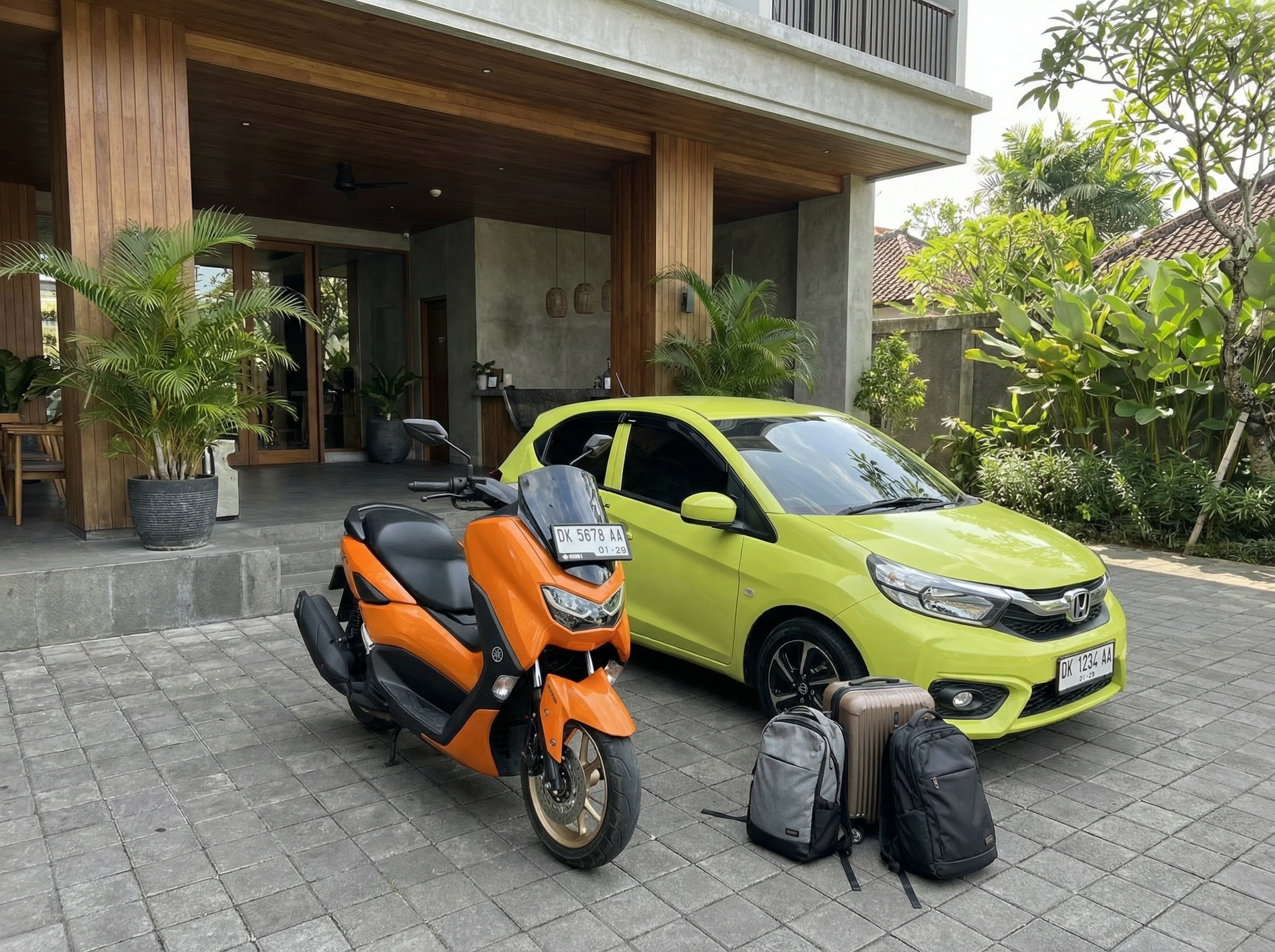
| If your trip looks like this | Better default | Why |
|---|---|---|
| Solo or couple, light luggage, many short daily hops | Scooter | Faster for stop-start Bali movement and easier to park |
| Couple with one bag each, mixed local riding, mostly dry-weather flexibility | Scooter or larger scooter class | Still efficient if you stay light and are comfortable riding |
| Three or more people, kids, stroller, surf gear, or multiple large bags | Car | Comfort and carrying capacity matter more than parking speed |
| Late arrival, airport transfer, hotel change day, or fixed appointment schedule | Car | Less friction when the day has luggage and timing pressure |
| Repeated short rides around Canggu, Seminyak, Kuta, or Sanur | Scooter | Daily convenience is usually the real advantage |
| Rainy-season evenings, longer inland loops, or all-day sightseeing | Car | Better weather cover, lower fatigue, easier day structure |
Scooters win in Bali when the main problem is not distance. The main problem is repeated short movement.
That usually means:
This is why a scooter often makes the most sense for:
If that sounds like your trip, go straight to the Bali scooter catalog for lighter everyday options or compare the Bali maxi-scooter catalog if you want more comfort and storage before you overthink the car option.
If the scooter side is winning because you are staying several weeks or a full month, the question becomes less about scooter versus car and more about daily comfort, storage, and model fit. Use the monthly scooter rental guide to compare long-stay scooter choices before you choose one scooter for repeated daily riding.
A car becomes the practical default when the trip is less about micro-mobility and more about moving people, bags, and timing safely through the day.
That usually means:
Cars also make more sense when one person in the group does not want the stress of balancing bags, weather, and road focus at the same time. If that is your trip shape, start with the car rental page instead of trying to force a scooter decision because it looks cheaper.
If you are stuck between both options, look at luggage first.
The mistake is treating luggage as a small detail because the island looks close on a map. In practice, transfer friction is what breaks the day. If your arrival, hotel move, or departure day involves real baggage, the car decision is often simpler than the scooter decision.
The weather question is not only "Can I ride in the rain?"
The better question is: "Do I still want to do this after a full day out, at night, or with a fixed dinner, airport, or hotel deadline?"
Scooters can still work in Bali's rainy season if:
Cars make more sense when:
For the full weather and safety angle, send readers who need the deep version to the existing rainy season guide.

This is the strongest scooter argument, and it stays true even when a car is more comfortable.
In many Bali travel patterns, a scooter saves time because it reduces all the little frictions:
That matters most in places where the trip is built from many short movements rather than one clean drive.
If your Bali days are mostly:
then a scooter often keeps the whole day lighter. The tradeoff is obvious: you get less comfort, less weather protection, and less carrying capacity.
Some routes in Bali look short until you combine:
Use this practical rule:
Ubud and Uluwatu are good examples. Both can work on a scooter, but both become more tiring when you add a second person, hills, heat, or all-day movement. That does not mean "never choose a scooter there." It means do not price-anchor yourself into the wrong vehicle for the route you actually plan to do.
This is where many travelers choose badly.
They compare a scooter's daily price to a car's daily price, then forget that arrival day and departure day have different rules.
That does not mean every Bali trip needs a car. It means the airport or hotel-transfer day should not be treated like a normal cafe-and-beach day.
If the main pressure in your plan is the transfer itself, the car answer is often cleaner. If the main pressure is daily flexibility after you have settled in, a scooter may still be the better full-trip choice.

Even after all the car arguments above, the scooter still wins very clearly in one situation: you want the fastest and cheapest way to move through many short Bali decisions.
A scooter still makes the strongest case when:
This is why some travelers end up with a simple split logic:
That hybrid pattern is often more realistic than trying to force one vehicle type to solve every kind of day equally well.
If the cheaper vehicle makes the arrival day, rain day, or long-trip day miserable, it was not the cheaper decision in practice.
If you are considering a scooter, make sure the document and rider-confidence side is real before booking around it. If the legal side is still unclear, use the Bali scooter license guide before assuming a scooter is automatically the right answer.
Also check the booking rules that affect the decision before you commit. The deposit and insurance guide explains what to expect around deposits, coverage language, and what is still your responsibility. The damage and liability guide is the better next read if you are worried about repair-cost surprises after damage.
Before payment or pickup, compare the exact listing, your booking confirmation, and the provider's rental agreement. The rental agreement guide is a practical checklist for that comparison, but you should still confirm the wording attached to your exact booking.
For solo travelers or couples doing short daily runs, a scooter is usually the easier choice. A car starts making more sense there when luggage, family travel, or rainy-season schedule pressure is the bigger issue.
Usually yes when you have real luggage, late arrival timing, or multiple passengers. A scooter can still work if you are traveling very light and you are not trying to force the airport transition into the same logic as the rest of the trip.
Sometimes, but once the luggage is real and the transfer day matters, a car is usually the cleaner answer.
Yes. Rain does not automatically kill the scooter option, but it raises the value of comfort, weather cover, and lower fatigue. That shifts more trips toward cars, especially at night or on fixed-schedule days.
A scooter usually wins on pure daily cost and short-hop efficiency, as long as you are light, comfortable riding, and not turning the trip into a luggage or weather problem.
This guide should stay focused on the vehicle-choice decision. For scooter document readiness, use the Bali scooter license guide.

If your trip is light, flexible, and built around many short runs, start with the Bali scooter catalog for lighter daily-use options or the Bali maxi-scooter catalog if you want more comfort and storage. If your trip includes luggage, family, fixed transfers, or weather-sensitive comfort, go straight to Bali car rental options. If you still want the broader Bali vehicle context before you choose, use the Bali vehicle rental guide. If the scooter route still looks attractive but you are not sure about document readiness, check the Bali scooter license guide before you decide. Before you pay or show up for pickup, compare the exact listing, booking confirmation, and rental agreement for that provider. Then use the deposit and insurance guide for upfront deposit and coverage questions, and the damage and liability guide for what happens if something goes wrong.

Yamaha Fazzio Red
A lighter city scooter for travelers whose Bali days are mostly short local hops, easy parking, and light luggage. It fits the guide's scooter-first branch for Canggu, Seminyak, and similar short-run bases.
IDR 145,000 / day

Honda PCX
A more comfortable scooter choice for riders who still want two-wheel flexibility but need a calmer, more premium fit for longer South Bali or mixed-base days.
IDR 210,000 / day

Daihatsu Ayla with Apple Car Play & Rear Camera
A budget-friendly city car for travelers who are moving away from scooters because of luggage, weather, or transfer friction but still want a smaller Bali car option. Live notes still show airport, Sanur, Canggu, and Ubud delivery-pickup fee bands.
IDR 300,000 / day

Toyota Avanza
An all-round family-oriented Bali car choice for days when passenger count and bag space matter more than the scooter's parking advantage. It is the cleaner branch once the trip stops being light and flexible.
IDR 350,000 / day
Choose from the real shape of the trip, not just the daily price, by checking luggage, weather, airport-transfer pressure, short city movement, and how far the day really needs to reach.
Map the real day, not the postcard route
Decide whether the trip is built from many short local runs or from longer, more fixed days with less slack.
Count passengers and bags first
If the day includes real suitcases, more than two people, or family travel, move the decision toward a car before you compare prices.
Check weather and schedule pressure
Rainy-season evenings, airport arrivals, and hotel-change days raise the value of weather cover and lower fatigue.
Choose the right branch
Pick a scooter when parking speed, flexibility, and repeated short movement are the real advantage. Pick a car when the day is luggage-heavy, passenger-heavy, or comfort-heavy.
Open the matching commercial page
Use `/rental-catalog` for the scooter branch, `/cars` for the car branch, the broader Bali vehicle rental guide when you want the wider comparison first, and the scooter license guide only if the two-wheel branch still needs a document check.


